



Last Updated: November 7, 2026
Quick Summary
High end dog beds for small breeds earn their price when they fit your dog's measured sleeping position, hold their shape after repeated washing, and have a low entry height a short leg can clear. Premium beds in this range can last 5 to 10 years, so cost per year often beats replacing a cheap bed twice.
- Measure your dog lying down, not standing, since standing measurements produce a bed that is too short once the dog curls.
- A bolster wall taller than about 4 inches is hard for a 6-inch leg to clear.
- For a 20-pound small breed, look for at least 18 x 18 inches of usable inner space.
- Senior dogs, dogs with joint stiffness, and breeds prone to patella issues gain the most from memory foam.
- Aventura Pups beds come in three sizes and are priced at $110.00, made in the USA.
Table of Contents
- What Makes a High End Dog Bed Worth It for Small Breeds
- How to Measure a Small Dog for a Bed That Fits
- The Best Dog Beds for Small Dogs: What to Look For
- Luxury Dog Beds for Small Dogs: Materials, Style, and Craftsmanship
- Do Small Dogs Need Orthopedic Dog Beds for Small Dogs?
- Washable Dog Beds for Small Dogs: Cleaning and Long-Term Care
- Shop Aventura Pups Beds in Three Sizes
- Frequently Asked Questions
What Makes a High End Dog Bed Worth It for Small Breeds
High end dog beds earn their price when they fit a small dog correctly, keep their shape after repeated washing, and suit how that dog actually sleeps.
Small dogs are not simply small versions of large ones.
Below, we explain how to size, judge materials, and decide whether orthopedic support is worth the upgrade.
East Perry's 2026 luxury dog bed analysis notes that premium beds in this range can last 5 to 10 years, which reframes the cost conversation. Divided across that lifespan, a well-made bed often costs less per year than replacing a cheap one twice.
How to Measure a Small Dog for a Bed That Fits
Measure your dog in its natural sleeping position, not standing up. A curled sleeper needs a bed roughly the length and width of the curl plus a few inches of margin. A sprawler needs a bed long enough for fully extended legs.
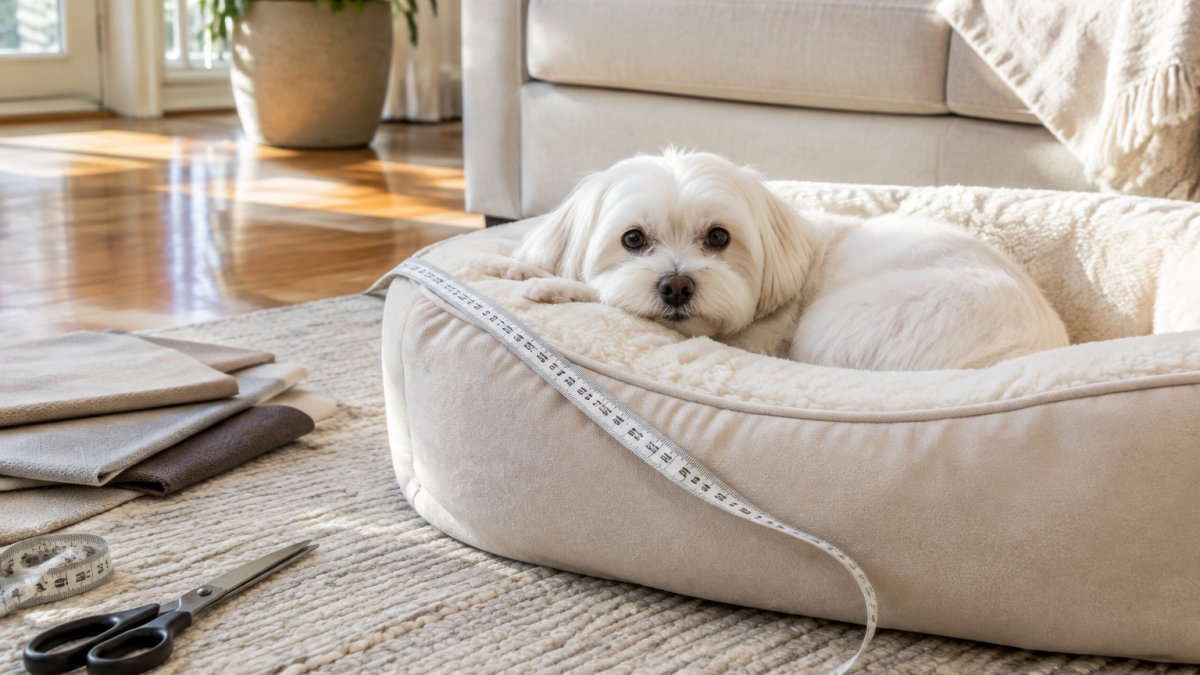
Here is the measuring routine we walk customers through:
- Length: measure from the tip of the nose to the base of the tail while the dog lies stretched out.
- Width: measure across the widest point of the ribcage, then add 2 to 3 inches.
- Curl allowance: for a curled sleeper, add 4 to 6 inches to the nose-to-tail length.
- Weight check: confirm the bed's weight range covers your dog with room to spare.
A buying guide cited by NBC News Select's veterinarian preference guidance gives a typical small-breed bed range of 18 × 16 to 26 × 22 inches, with raised edges or pockets often preferred for dogs under 30 pounds.
Match the Bed to How Your Dog Actually Sleeps
Weight charts alone will not tell you which bed a toy breed will use. Sleep position is the better filter, and it is the step most sizing guides skip.
- Curled sleepers (Chihuahuas, Maltese, Pomeranians) tuck into a tight ball and rely on a raised edge or bolster to feel enclosed. Choose a bed whose inner resting area is only 2 to 4 inches longer than the curl, with a bolster high enough to rest a chin on but low enough for a 6-inch leg to step over.
- Sprawlers (French Bulldogs, Pugs, some Terriers) stretch flat with legs extended. They need a flat lounger or low-profile bed long enough for the full nose-to-tail stretch plus 2 inches, with no high walls that block entry.
- Burrowers (Dachshunds, some Spaniels) push bedding into a pile. A bed with a loose, deep cushion or a cave-style design suits them better than a tight bolster.
Measure the Inner Resting Area, Not the Outer Footprint
A bed with a generous outer footprint but a cramped inner area defeats the purpose. Compare inner dimensions, not just the exterior. For a 10-pound dog, an inner area under about 14 × 14 inches starts to feel tight once the dog curls; for a 20-pound small breed, look for at least 18 × 18 inches of usable inner space. If the listing only gives exterior dimensions, subtract the bolster width on each side before you decide.
Entry Height and Accessibility for Small Frames
Short-legged breeds and senior small dogs need a low entry height. A bolster wall taller than about 4 inches is hard for a 6-inch leg to clear, and a senior dog with arthritis may stop using a bed it cannot step into.
Watch out: measuring a standing dog produces a bed that is too short once the dog curls, and a bed that is too large removes the sense of enclosure small breeds rely on to settle.
The Best Dog Beds for Small Dogs: What to Look For
The best dog beds for small dogs share four traits: correct dimensions, a filling that resists flattening, a washable construction, and a low entry height. Everything else, from color to trim, is preference. A bed that fails any of those four will disappoint regardless of price.
| Feature | Why It Matters for Small Breeds | What to Avoid |
|---|---|---|
| Dimensions | Prevents sinking and lost enclosure | One-size "small" labels |
| Filling | Holds shape, cushions pressure points | Loose clumps that shift |
| Washability | Handles accidents and odor | Covers that pill or shrink |
| Entry height | Keeps joints and tiny legs comfortable | High walls on a tiny frame |
A common mistake is choosing a bolster bed for a dog that sprawls flat. Bolster designs suit curled sleepers who like to rest a chin on a raised edge; loungers suit dogs that stretch out.
Our washable dog beds for small dogs skip the cover liner and zipper entirely.
Luxury Dog Beds for Small Dogs: Materials, Style, and Craftsmanship
High end dog beds for small dogs separate themselves through materials and construction, not marketing. Animals Matter's luxury bed range describes its designer beds as high-end products built around orthopedic support, with low-entry nesting styles and plush filling for comfort. That combination, quality filling plus a shape small dogs can enter easily, is what justifies the price.
Craftsmanship shows up in the seams and the filling, not only the fabric pattern. Ask how the bed is cleaned before you buy; a bed you cannot wash will not stay luxurious for long.
Material and Safety Transparency: What to Ask Before You Buy
Most luxury listings tell you the color and the cover fabric but not the numbers that predict how the bed will perform. Use these criteria to compare beds on equal footing:
- Foam density: orthopedic foam is usually rated in pounds per cubic foot (PCF). Ask for the density, not just the word "orthopedic."
- Fabric composition: look for the percentage of cotton, polyester, and any performance fiber. A high-polyester cover resists pilling and shrinking; a cotton-rich cover feels softer but may pill faster. Neither is automatically better, but the label should state the blend.
- Certifications: foam and fabric certifications such as CertiPUR-US for foam and OEKO-TEX Standard 100 for textiles are common public benchmarks. A bed that carries one has been tested for certain chemical content; a bed that does not may still be fine, but you cannot verify it from the listing.
- Odor: new foam can off-gas. A mild foam smell that fades within a few days is normal; a strong chemical smell that persists is a reason to return the bed.
- Chew resistance: no fabric bed is chew-proof. For a determined chewer, look for tight-weave covers, reinforced seams, and no loose trim or zipper pulls that invite chewing. If your dog destroys beds, a chew-resistant cover or a bed with hidden zippers is the safer choice.
Style and Craftsmanship Details That Predict Longevity
Style is preference, but construction is not. Check the seam at the bolster-to-base junction, the most common failure point on a bolster bed; a reinforced double stitch there outlasts a single stitch. Check whether the filling is sewn into channels or left loose; channeled filling shifts less and keeps its shape through washing.
For a small dog, the inner resting area is the number that matters. Compare inner dimensions, not just the exterior, and confirm the entry height suits a short-legged or senior frame before you pay for craftsmanship you cannot use.
Do Small Dogs Need Orthopedic Dog Beds for Small Dogs?
Some small dogs benefit greatly from orthopedic dog beds for small dogs, and others do not need one. Senior dogs, dogs with joint stiffness, and breeds prone to patella issues gain the most from memory foam and layered support.
Orthopedic construction works through foam layers that distribute weight and relieve pressure at the hips, shoulders, and elbows.
- Senior dog: prioritize pressure relief and low entry height.
- Puppy: prioritize washability and a firm, supportive base.
- Active adult toy breed: prioritize comfort and a shape that matches sleep style.
If your dog is between categories, choose support over plushness. Joint comfort is harder to add later than cushioning.
Washable Dog Beds for Small Dogs: Cleaning and Long-Term Care
Washable dog beds for small dogs should survive the washer and dryer without losing shape, and that durability is where cheap beds fail. Small breeds have small bladders, so accidents happen, and a bed that cannot be cleaned thoroughly becomes a smell problem within months.
The care routine that keeps a bed in service for years:
- Shake out loose hair weekly.
- Wash on a gentle cycle with a mild detergent.
- Dry fully before the dog returns to it.
- Check seams and filling monthly for compression.
- Rotate the bed occasionally so it wears evenly.
A removable cover helps, but zippers and liners add failure points. A bed designed to go straight into the washer and dryer, with no liner or zipper, is simpler to maintain.
Shop Aventura Pups Beds in Three Sizes
Our Aventura Pups beds come in three sizes, so a small breed gets a genuine fit rather than a scaled-down large bed. Each is a super-soft luxury bed with no cover liner or zipper: throw it in the washer and dryer, and it comes out looking new wash after wash. Each bed is proudly made in the USA and priced at $110.00.
Sizes run small at 10 x 14 inches, medium at 13 x 18 inches, and large at 20 x 27 inches. You can shop the A/P Baby Blue bed for a soft blue tone, or compare the A/P Carnation colorway if you want a warmer pink. Shoppers drawn to a richer neutral can view the A/P Caramel Rabbit finish, while anyone matching a pastel palette can browse the A/P Angora Pink bed. For a cooler, understated look, see the A/P Angora Platinum option before you decide.


Best for: small breeds that curl to sleep and need a washable, made-in-the-USA bed. Skip if: your senior dog needs firm orthopedic foam support.
Choosing a bed for a small breed comes down to fit, filling, and washability, and getting those right is what separates a bed that lasts from one that flattens in a season. Aventura Pups builds beds around small-dog proportions, with super-soft construction, no zipper or liner to fail, and three sizes to match a real measurement.
Frequently Asked Questions
Are high end dog beds worth the price?
It depends on how much durability and comfort you want. Premium dog beds vary widely in price, and a durable bed can cost less per year than replacing cheap beds often. Aventura Pups beds are $110 in three sizes, made in the USA, and machine washable and dryable, which supports long use.
How do I choose the right size bed for a small dog?
Measure your dog from nose to tail base and add a few inches for stretching, then check the bed's inner resting area. Aventura Pups beds come in Small (10 x 14 inches), Medium (13 x 18 inches), and Large (20 x 27 inches). Curled sleepers can use a snugger fit, while sprawlers need more room, so match the bed to your dog's sleeping position.
Do small dogs need orthopedic dog beds for small dogs?
Not every small dog needs one, but senior dogs, dogs with joint issues, and breeds prone to patella problems benefit from added support and pressure relief. If your dog is a puppy or a healthy adult, a plush, supportive bed may be enough. Look for foam layers or memory foam if your vet recommends orthopedic support.
How often should you wash a dog bed?
Most beds should be washed every two to four weeks, and more often if your dog sheds heavily or has accidents. Aventura Pups beds have no cover liner or zipper, so you can throw the whole bed in the washer and dryer. That design makes routine cleaning simpler and helps the bed hold up wash after wash.

