



Quick Summary
A bull dog toy lasts when its size, materials, and construction match how your dog actually plays. Choose a toy that fits between your bulldog's molars, made from dense rubber or reinforced fabric with double-stitched seams, and inspect it before every session.
- Measure your bulldog's mouth width and check that the toy sits between the molars without stretching the jaw.
- Pick dense rubber or reinforced fabric, and avoid glued-on parts that tend to separate first.
- Look for thicker walls, double-stitched or bound seams, and no metal rings or small clips.
- Squeeze, seam-check, and pull-test the toy before and after each session, and retire it at first sign of damage.
- Choose softer chew toys for puppies and tougher ones as chewing strength grows.
Table of Contents
- Why Bulldogs Need Toys Built for Power Chewing
- Matching Toy Size to Your Bulldog's Mouth and Build
- Durability, Materials, and Safety for Rough Play
- Choosing the Best Chew Toy for an English Bulldog Puppy
- Why Interactive Dog Toys Keep Bulldogs Busy
- Where KONG Dog Toys Fit in a Bulldog's Rotation
- Pick Your Bulldog's Next Toy and Check Fit Before You Buy
- Frequently Asked Questions
Why Bulldogs Need Toys Built for Power Chewing
Last Updated: November 7, 2026
A bull dog toy that lasts is one of the most useful purchases an English Bulldog owner can make.

Owners often buy an attractive plush or a thin rubber toy, and within a short time the stuffing can come out or a chunk can go missing.
Research on dog play points in the same direction. A 2023 study on introducing new toys to companion dogs reported a slight improvement in some positive outcomes (study on short-term provision of toys to companion dogs).
Toy categories matter too. Market analysts expect dog toys to account for the largest share of the broader pet-toy market, with one forecast putting the segment at a 67.57% share in 2026 (Fortune Business Insights pet toys market report).
Here is the core idea for the rest of this guide: a bull dog toy lasts when its size, materials, and construction match how your dog actually plays. Let's start with fit.
Matching Toy Size to Your Bulldog's Mouth and Build
A toy that is too small invites swallowing, and one that is too large frustrates a dog and makes it hard to hold.
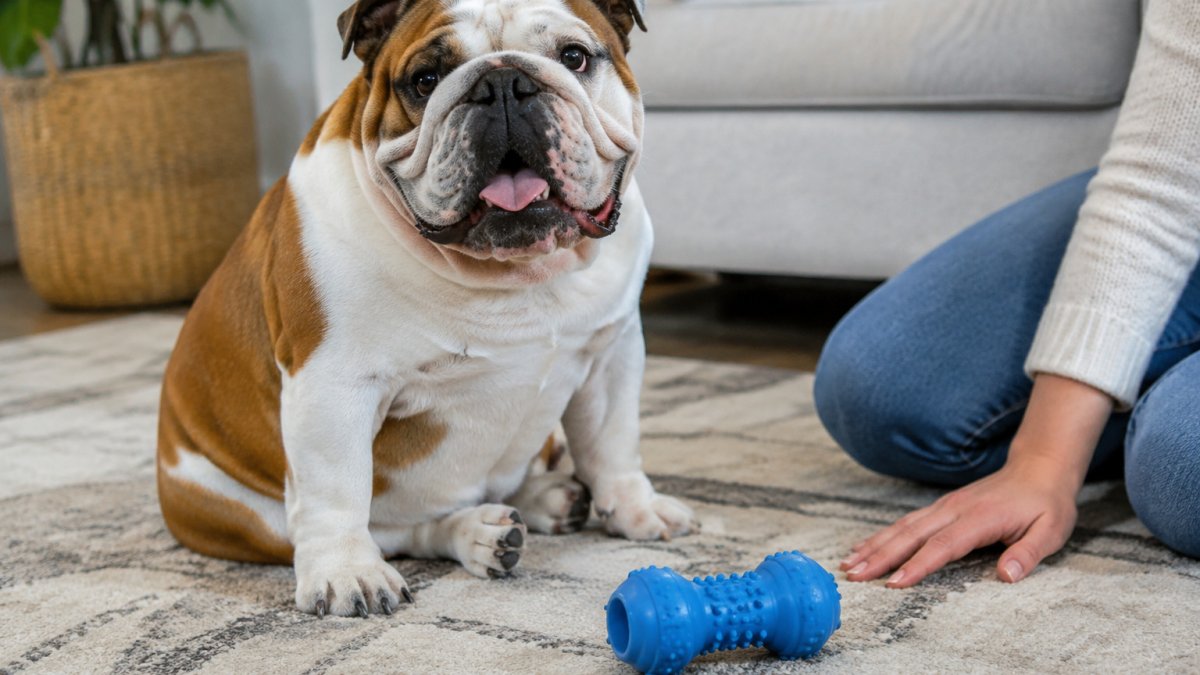
!Stout English Bulldog sitting on a living room rug beside a sturdy rubber chew toy, owner's hand resting nearby for scale
Build matters as much as mouth size.
Watch how your dog handles a toy during the first few sessions. If it carries the toy with its front teeth only, the toy may be too big.
Durability, Materials, and Safety for Rough Play
Durability is not a single property. A bull dog toy survives rough play when four things line up: material density, wall thickness, seam construction, and how the toy is sized relative to your dog's mouth. Change one and the failure mode changes with it.
Start with material. Dense natural or synthetic rubber resists punctures because it flexes and recovers instead of tearing. Tightly woven, reinforced fabric with double-stitched seams holds up better than loosely stitched plush or thin vinyl.

Then look at construction details you can check before purchase:
- Wall thickness: thicker walls resist punctures longer, but a toy that is too rigid can crack rather than flex.
- Seam style: double-stitched or bound seams distribute stress better than single stitching.
- Openings: a hollow toy with a small treat opening is easier to inspect and clean than one with hidden cavities.
- Hardware: avoid metal rings, split rings, or small plastic clips that can be worked loose.
A Practical Inspection Routine
A quick check before and after each session can catch problems before they become hazards. Run this sequence:
- Squeeze the toy along its full length. Soft spots or a sudden give often mean an internal crack.
- Run a thumb along every seam. A seam that separates under light pressure is already failing.
- Check openings and edges for nicks, tears, or exposed filling.
- Test attached parts, squeakers, ropes, tags, with a firm pull. If it moves, it can come off.
- Retire the toy at the first sign of cracking, tearing, or exposed stuffing. Do not wait for a piece to come loose.
Watch out: a toy that looks intact on the outside can hide a cracked core after heavy chewing, so squeeze-test hollow toys rather than relying on a visual check alone.
Choking Hazards and Supervision
The real hazard is not wear in general, it is fragments. Stuffing, squeakers, crinkle film, and torn fabric pieces are the parts most often swallowed.
A common pattern is that a determined chewer focuses on one weak point, a seam, an ear, a squeaker opening, and works it until it fails. If your dog fixates on one spot, that toy belongs in supervised-only play or out of the rotation entirely.
Plush Toys: When They Are Safe and When They Are Not
Plush toys suit gentle play, cuddling, and carrying. They are a poor match for a dog that tears fabric. Choose plush with reinforced stitching and embroidered or stitched features rather than loose plastic eyes or glued-on parts, and retire any plush the moment a seam loosens.
Squeakers, Crinkle Features, and Stuffing Risks
Squeakers and crinkle layers add interest, but a dog that extracts a squeaker may swallow it. For serious chewers, choose toys with no squeaker or with the squeaker sealed inside a tough stitched chamber. Remove any squeaker that becomes exposed, and step in if your dog starts pulling at fabric.
Cleaning and Long-Term Value
Cleaning is part of durability. Check the manufacturer's instructions for cleaning guidance before assuming a toy is dishwasher safe. Fabric toys vary widely: some are machine washable, others are surface-clean only, and heat can weaken seams. A toy you can clean easily tends to last longer and stay in the rotation, which is the real measure of value.
Bulldog-Shaped Toys vs. Toys Built for Bulldogs
Not every bull dog toy is meant for a dog. Bulldog-shaped plush and figurines are often child-oriented or collectible products, and their stitching, filling, and small parts are not designed for chewing. Toys built for bulldogs are sized and constructed for jaw pressure and play style. Before buying, confirm which category you are shopping in: a collectible bulldog plush is a display or gentle-carry item, while a chew-rated toy is a play item. Mixing the two up is one of the most common buying mistakes.
Choosing the Best Chew Toy for an English Bulldog Puppy
Puppies need chewing for teething relief and for learning how their mouths work, but their jaws and teeth are still developing. For a bull dog puppy, choose a softer, flexible chew toy sized so the puppy can hold it easily. Avoid very hard toys that can damage developing teeth.

Supervise every session with a new toy, and pick toys that are designed for puppies rather than adult power chewers. As your puppy grows and its chewing gets stronger, move up to a tougher bull dog toy and keep an eye on wear.
Why Interactive Dog Toys Keep Bulldogs Busy
Interactive toys give a bulldog a job. Instead of passive chewing, the dog works out how to free a treat or kibble, which stretches engagement and can help during quiet periods or short absences. The key is matching the puzzle's difficulty to your dog's persistence and jaw style.
Interactive toys generally fall into a few types:
- Treat-dispensing chew toys: a hollow rubber body with a small opening. Kibble or soft treats tumble out as the dog rolls and chews. Durable and simple, but easy for food-motivated dogs to solve quickly.
- Puzzle boards and sliders: compartments the dog noses or paws open. Good for mental work, but usually better for supervised floor play than for chewing.
- Hide-and-seek and snuffle toys: fabric pockets or folded layers that hide treats. Engaging for scent-driven dogs, but fabric construction means they are not chew toys.
- Tug and chase toys: ropes, balls, and flexible shapes that invite movement. These burn energy but require a human play partner.
Matching Difficulty to Your Dog
A puzzle that is too easy loses interest in minutes; one that is too hard causes frustration and abandonment. Start with a treat-dispensing toy and adjust the opening or treat size to change difficulty. If your dog solves it in under a minute, move to a multi-step puzzle. If your dog walks away, make the reward easier to reach.
Watch out: puzzle boards with small sliding pieces can be chewed and broken by a determined bulldog, so inspect them after each session and store them out of reach when not in use.
A Side-by-Side Comparison Framework
Rather than guessing, compare interactive toys on the same criteria:
| Criterion | What to Check | Why It Matters |
|---|---|---|
| Size | Fits comfortably in the mouth; no small parts | Prevents swallowing and frustration |
| Material | Dense rubber vs. fabric vs. plastic | Determines chew safety and lifespan |
| Play style | Solo dispensing vs. supervised puzzle vs. tug | Matches how your dog actually plays |
| Durability | Wall thickness, seam style, fixed parts | Predicts failure points |
| Cleaning | Dishwasher safe, hand wash, surface only | Affects long-term value and hygiene |
| Price | Cost per month of expected use | Compares value, not just sticker price |
Use the table as a checklist before buying. A toy that scores well on size and material but poorly on cleaning may still be worth it for a dog that only uses it briefly; a toy that scores well everywhere but is too small for your dog's mouth is a no.
Fit and Play Needs, Not Breed Stereotypes
Bulldogs vary widely in size, jaw shape, and chewing habits. A toy that suits one bulldog may be wrong for another. Judge fit by your dog's mouth width, how it carries the toy, and whether it targets one weak point. Avoid breed-wide claims; use observed behavior instead.
Where KONG-Style Toys Fit
Hollow rubber treat toys are a common long-lasting option in a rotation because the material is dense and the shape holds treats. Treat any such toy as a tool that still needs supervision and regular inspection, and pair it with softer toys for gentler play.
Where KONG Dog Toys Fit in a Bulldog's Rotation
No single toy suits every dog. Use the fit and durability checks above before you buy, and treat any KONG-style toy as a tool that still needs supervision.
Pick Your Bulldog's Next Toy and Check Fit Before You Buy
Start with size: confirm the toy fits your bulldog's mouth and build. Next, match material to play style, with dense rubber or reinforced fabric for heavy chewers and softer options for puppies and gentle dogs. Check seams, squeakers, and loose parts before every session, and retire any toy that shows damage.
Browse our collection to find a bull dog toy that matches your dog's size and play style, and check the product details before you order.
Frequently Asked Questions
What is a good toy for a bulldog?
A good bull dog toy is sized so the dog cannot fit it fully into its mouth, made from a tough material such as solid rubber or dense nylon, and free of parts that break off. Bulldogs are strong chewers with a broad jaw, so look for toys labeled for aggressive chewers. Rotate two or three toys so the dog stays interested. Supervise any new toy during the first few sessions, and replace it once it shows cracks, missing pieces, or loose stitching.
Are plush toys safe for bulldogs?
Plush toys can be safe for supervised play, but many bulldogs tear them apart quickly and swallow stuffing or squeaker parts. Choose plush toys with reinforced seams and no loose buttons or eyes, and remove them once the outer fabric is damaged. Many owners reserve plush toys for calm play and give power chewers a solid rubber or nylon option instead. If your dog swallows fabric or stuffing, contact your veterinarian promptly.
What size toy should I get for my bulldog?
Measure your bulldog's muzzle width and head size, then choose a toy too large to fit fully in the mouth. A toy that is too small becomes a choking hazard, while one that is too large can be hard to grip and may strain the jaw. For a typical adult English Bulldog, look at large or extra-large sizing rather than standard sizes. Check the product's listed dimensions rather than relying on a generic size label.
How can I keep my bulldog busy with toys?
Interactive dog toys that hide treats or require pushing and pulling can hold a bulldog's attention for longer than a toy that is simply thrown. Rotate toys every few days so they feel new, and use food-dispensing toys during crate time or when you leave the house. Short, frequent play sessions often work better for bulldogs than long ones, since they tire easily in warm weather. Always supervise play with any toy that can be chewed apart.

