



Last Updated: November 5, 2026
Quick Summary
Reflective collars improve puppy safety by bouncing headlight beams back toward drivers, so a small dog is spotted sooner in low light. This longer detection distance buys drivers reaction time on dim residential streets. Reflective collars need no battery and never die mid-walk.
- A 2025 review reports all tested collars could potentially generate enough pressure to cause injury in dogs.
- Check collar fit every seven days during weeks 8 to 16, the steepest growth window.
- Slide two fingers flat under the collar; they should pass with light resistance.
- Replace a collar when the reflective strip has cracked, peeled, or gone cloudy.
- Test gear at dusk by shining a phone flashlight from about 20 to 30 feet away.
Table of Contents
- How Reflective Collars Improve Visibility on Low-Light Walks
- Puppy Collar Safety: What Every New Owner Should Know
- Puppy Collar Fit and Sizing for a Fast-Growing Dog
- Reflective Collar vs LED Dog Collar: Which Wins After Dark?
- Collar or Harness for Puppies? Choosing the Right Walking Setup
- The Limits of Reflective Gear and How to Test Visibility
- Build a Complete Low-Light Walking Routine for Your Puppy
- Shop Reflective Leads and Collars at Aventura Pups
- Frequently Asked Questions
How Reflective Collars Improve Visibility on Low-Light Walks
The benefits of reflective collars for puppy safety start with one simple fact: a driver sees a reflective strip before they see a dog. Reflective collars are dog collars made with a retroreflective strip that bounces headlight beams back toward the driver, making a small dog far easier to spot in low light.
Puppies are short, fast, and unpredictable. They dart. They stop dead in the middle of a sidewalk. In dim light, that combination is hard for a driver to track.
How Reflective Material Returns Light to Drivers
Retroreflection is the process where a surface sends light back toward its source instead of scattering it in all directions. That is the whole trick.
Standard fabric absorbs most light. Reflective material returns it. That difference is why a dog in a plain collar can vanish at dusk while the same dog in a reflective collar shows up clearly in a beam.
The result is a longer detection distance. Drivers spot the reflection sooner, which buys reaction time. That extra second matters most on residential streets with parked cars and short sight lines.
Puppy Collar Safety: What Every New Owner Should Know
Puppy collar safety is not just about being seen. It is also about fit, pressure, and supervision. A 2025 review of walking gear published in a peer-reviewed collar and harness review reports that all tested collars could potentially generate enough pressure to cause injury in dogs.
A few habits keep a young dog safe:
- Check the fit weekly, since puppies grow fast
- Remove the collar for crate time and unsupervised play
- Watch for rubbing or hair loss at the neck
- Keep the ID tag light so it does not drag
- Introduce the collar slowly, with treats and praise
Watch out: leaving a collar on a crated puppy is a real snag risk. Take it off before your dog goes in.
If your puppy fusses about wearing a collar at all, our guide on how to train a puppy to wear a collar calmly walks through the slow introduction step by step.
Puppy Collar Fit and Sizing for a Fast-Growing Dog
Puppy collar fit and sizing is a moving target, because the neck you measure this month is not the neck you will have next month. Puppies can grow quickly, so their neck size can change over the first year. A collar that fits perfectly at ten weeks can be uncomfortably snug by fourteen. That is why fit is a routine, not a one-time measurement.
The Two-Finger Check, Done Right
Slide two fingers flat under the collar at the neck. They should pass with light resistance, not slide freely, and not require a push. If you can fit three fingers easily, the collar is loose enough that a determined puppy may back out of it. If two fingers pinch, it is too tight.
Measure with a soft tape at the widest part of the neck, then add about two fingers' width of room for growth. Write the measurement and the date on a note or in your phone, so the next check has a baseline.
A Realistic Resize Schedule
- Weeks 8-16: check every seven days. This is the steepest growth window for most breeds.
- Months 4-6: check every two weeks.
- Months 6-12: check monthly, and after any noticeable weight change.
- After every bath or swim: recheck, since some straps shrink slightly when wet and relax as they dry.
An adjustable collar is the practical choice for a puppy precisely because you will move the buckle several times in the first year. A fixed-size collar bought for a eight-week-old is a short-term purchase.
Watch out: a collar that becomes too tight does not always look tight. Watch for a strap that leaves a visible groove in the coat, hair thinning or a bald patch at the neck, a puppy that scratches at the collar more than usual, or a buckle that has crept to the last hole. Any of those means resize now, not at the next scheduled check.
When to Replace Rather Than Resize
Resizing handles growth. Replacement handles wear.
Weight matters too. A heavy buckle on a tiny neck is uncomfortable and can rotate the collar so the reflective strip faces the chest instead of outward. Light hardware keeps the strip where drivers can actually catch it.
When you are ready to pick a style, our personalized dog collars for puppies guide covers sizing and fit in more detail.
Reflective Collar vs LED Dog Collar: Which Wins After Dark?
The reflective collar vs LED dog collar question has a clear answer for most puppies: reflective wins on comfort and durability, while LED wins on active glow. Reflective gear needs no battery and never dies mid-walk. An LED collar is self-illuminating, so it shows up even without a light source pointed at it.
Here is how they compare:
| Feature | Reflective Collar | LED Collar |
|---|---|---|
| Power source | None needed | Battery or rechargeable |
| Works without headlights | Limited | Yes |
| Weight on a small neck | Light | Heavier |
| Maintenance | Wipe clean | Charge and replace |
| Best for | Everyday walks | Extra glow on dark routes |
Many owners use both. A reflective collar handles daily walks, and a small LED clip adds a glow for the darkest routes. Just keep the total weight low on a puppy.
Collar or Harness for Puppies? Choosing the Right Walking Setup
Collar or harness for puppies is really a question about pulling and neck pressure. A harness spreads force across the chest instead of the throat, which many owners prefer for a puppy still learning to walk on a leash.
The practical setup for most puppies is a flat or reflective collar for tags, plus a harness for walks. That pairing gives you visibility, identification, and comfort in one routine.
Sizing a harness takes a chest measurement, not a neck measurement. Our dog harness size fitting guide shows where to measure. If you have a small breed, our roundup of the best dog harness for small breeds narrows down the options.
The Limits of Reflective Gear and How to Test Visibility
Reflective gear has real limits, and honest owners should know them before they rely on a collar to keep a puppy safe. The most important one: retroreflection is directional. A strip bounces light back toward the source, which means it is brightest to a driver whose headlights are aimed at it. A pedestrian approaching from the side, a cyclist crossing at an angle, or a driver whose beams are pointed elsewhere may see much less. A reflective collar is not a force field, it is a signal that works best when a light is pointed at it.
What Reflective Gear Cannot Do
- It does not glow on its own. On a pitch-black path with no headlights, a reflective strip stays dark. It needs an external light source.
- It does not cover every direction. A collar wraps the neck, so the strip faces outward in a ring, but a puppy's chest, legs, and tail are unmarked. A reflective leash or harness fills in the silhouette.
- It fades with wear. Dirt, scratches, and UV exposure all reduce return brightness. A strip that looks fine in daylight can be dull at night.
- It is not a substitute for a light. On unlit routes, carry a small flashlight or clip a light to the leash so you can see the puppy and others can see you.
Coat Color and Contrast Matter
A reflective strip is only half the visibility story. The collar's base color and the puppy's coat affect how easily the dog is picked out at dusk. A dark collar on a dark-coated puppy blends into the background until the strip catches a beam; a lighter or high-contrast collar helps the dog register as a shape even before the reflection kicks in. In rain or fog, contrast matters more, because water droplets scatter light and soften edges.
A Simple At-Home Visibility Test
Test your gear before you rely on it:
- Stand in a dim driveway or garage at dusk, not full daylight.
- Shine a phone flashlight at the collar from about 20-30 feet away, roughly the distance a driver first notices a small dog.
- Check that the strip glows back brightly and evenly, with no dark patches.
- Wipe the strip with a damp cloth and retest. If the reflection improves noticeably, the gear was dirty.
- Look at the strip from an angle, not just straight on, to see how the reflection falls off.
Cleaning, Inspection, and Replacement
Clean reflective gear monthly, and more often in winter or on dusty routes. Use a damp cloth with mild soap; avoid abrasive cleaners and scrubbing, which scratch the reflective surface. Inspect the stitching at the buckle and D-ring for wear and tear, and flex the strip to check for cracking or peeling.
Watch out: a reflective strip that has peeled, cracked, or gone cloudy is no longer doing its job, even if the collar still fits. Replace it rather than waiting for the next scheduled check.
Build a Complete Low-Light Walking Routine for Your Puppy
A complete low-light routine combines visibility, route choice, and timing. Walk facing traffic so drivers see you sooner. Stick to sidewalks and well-lit streets. Keep the leash short near intersections, and cross only at corners.
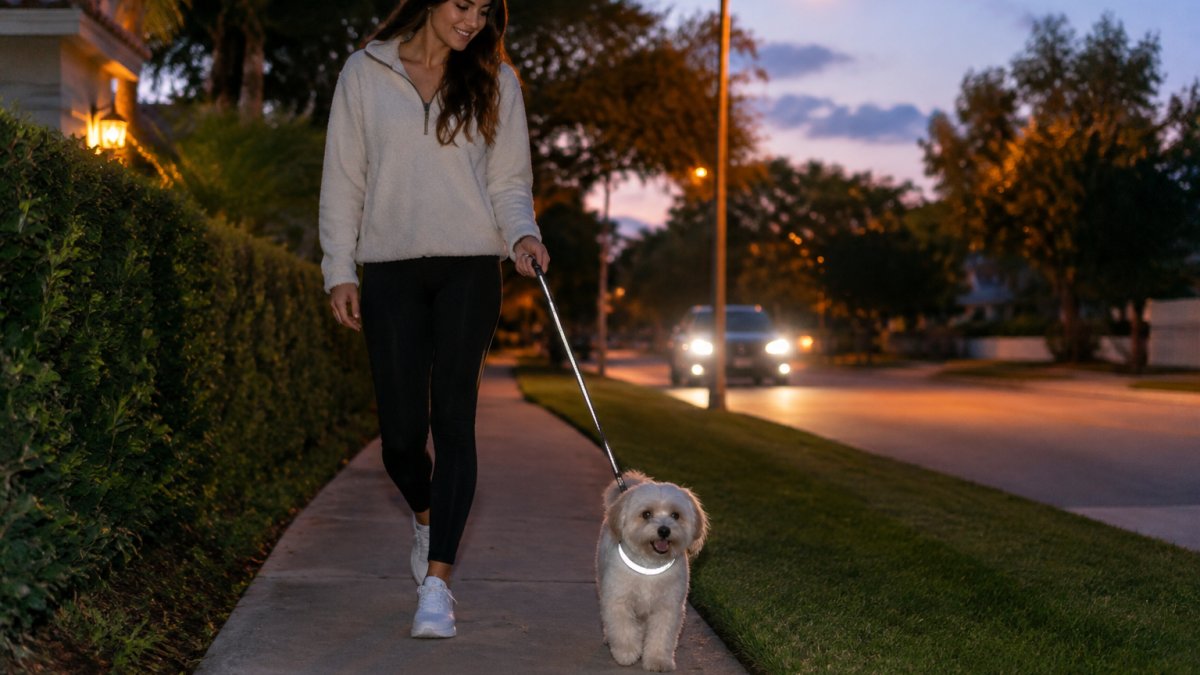
Add a reflective leash to the setup, and carry a small light for unlit stretches. Dress yourself in something bright too, since drivers see the tallest, brightest shape first. Watch the weather: rain and fog cut visibility, so shorten the route on those nights.
Shop Reflective Leads and Collars at Aventura Pups
Our Crystal Rope Pink lead is a high-traction reflective lead made for small dogs, with a full diamond design. At $58.00, it is priced at $58.00.
Aventura Pups offers stylish dog accessories, and many of our pieces are handmade in the USA.
Ready to make evening walks safer and more elegant?
Frequently Asked Questions
Are reflective dog collars safe for puppies?
Reflective collars are safe when they fit correctly and you supervise your puppy while wearing one. Collars can put pressure on a dog's neck, so fit matters more than the reflective feature itself. Choose an adjustable collar that leaves room for two fingers under the strap, check it weekly as your puppy grows, and never leave a collar on an unsupervised puppy in a crate.
How do reflective collars improve a puppy's visibility at night?
Reflective collars use retroreflection, which returns light back toward its source, so a driver's headlights bounce straight back to the driver rather than scattering. That makes a small puppy far easier to spot on a dark sidewalk or shoulder. Reflective features do not replace a leash or your attention, but they add a clear detection cue for drivers, cyclists, and other walkers in low-light conditions.
Should a puppy wear a reflective collar or a harness on walks?
Many owners use both: a fitted reflective collar holding ID tags, plus a harness for the leash. A harness spreads pulling force across the chest, which suits puppies still learning leash manners. Pick a harness that does not rub the shoulders, and keep the collar snug enough that it cannot slip over the head.
Are reflective collars effective in daylight?
Reflective material only lights up when a light source hits it, so in bright daylight it looks like an ordinary collar. Its value comes at dusk, dawn, and after dark, when headlights and streetlights trigger the reflection. For daytime walks, a bright color still helps, but pair reflective gear with a leash and close attention whenever light fades.
Evening walks do not have to be a trade-off between safety and style. Aventura Pups offers reflective leads and designer accessories made with premium materials and careful craftsmanship, with many pieces handmade in the USA. Browse our reflective leads and collars to find the right fit for your puppy. Get started with Aventura Pups and walk after dark with confidence.

