



Table of Contents
- Why Personalized Dog Collars for Puppies Are Worth the Investment
- Puppy Collar Sizing Guide: Finding the Right Fit
- How to Measure a Puppy for a Collar in 4 Steps
- Safe Materials for Puppy Collars: What to Look For
- Engraving vs. Embroidery: Personalization Methods Compared
- Safety Features and Breakaway Mechanisms for Puppies
- Caring for Your Puppy's Personalized Collar
- Frequently Asked Questions
Last Updated: September 10, 2026
Why Personalized Dog Collars for Puppies Are Worth the Investment
A puppy's first collar is more than a fashion statement. It is the piece of gear that carries your phone number if your dog slips a leash, and it is the item you will look at every single day for the next year. Owners often buy a cheap collar at eight weeks, which the puppy outgrows by sixteen weeks, and the identification tag can become illegible. Personalized dog collars for puppies solve that problem by putting your contact information directly on the collar itself, so there is no dangling tag to snag, jingle, or fall off. According to the American Kennel Club's guidance on pet identification, a collar with current contact details remains the fastest way for a finder to reunite you with a lost dog. The investment pays off in safety first, style second.
Puppy Collar Sizing Guide: Finding the Right Fit
The correct collar size leaves room for two fingers between the collar and your puppy's neck (akc.org). Any tighter restricts breathing and swallowing; any looser and the puppy can back out of it during a walk.
For a puppy collar sizing guide, the number that matters is neck circumference, not the size label on the package. A collar that fits a 10-week-old Labrador will not fit the same dog at six months. Measure the neck, add roughly one inch of growing room for young puppies, and re-check the fit every two weeks.
Puppy Growth Stages and Collar Sizing
Puppies pass through distinct growth phases, and collar sizing needs to move with them. During the rapid growth stage, from roughly eight weeks to six months, neck circumference can change noticeably month to month. Most owners find they need two collar sizes before the dog reaches adulthood. A common mistake is buying the adult size upfront and hoping the puppy grows into it, which leaves the collar loose enough to slip off at exactly the age when a puppy is most likely to bolt. Adjustable hardware with many holes handles this better than a fixed-size collar.
How to Measure a Puppy for a Collar in 4 Steps
Learning how to measure a puppy for a collar takes about two minutes and prevents a return or, worse, a lost dog.
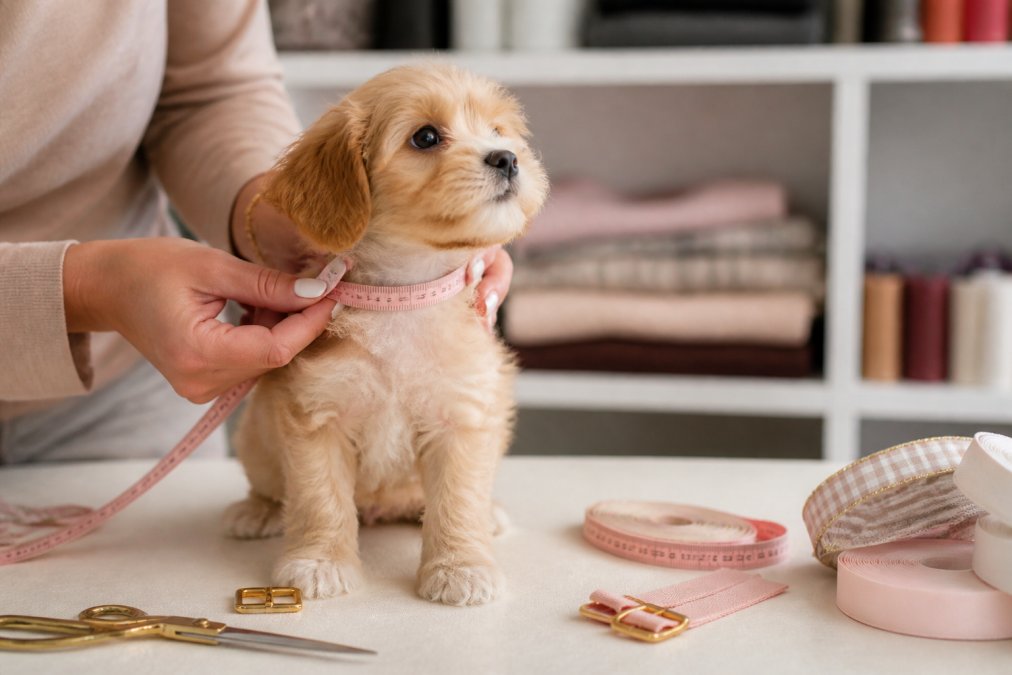
- Use a soft measuring tape. A cloth tape or a piece of string you later lay against a ruler both work. A stiff tape measure distorts the reading on a small neck.
- Measure the widest point. Wrap the tape around the middle of the neck, just below where the collar naturally sits, and record the circumference in inches.
- Add growing room. For a puppy still in a growth phase, add about one inch to the measured number. For an adult dog, add roughly half an inch.
- Test the fit. Slip two fingers under the collar once it arrives. If you can fit two comfortably, the fit is right. If not, adjust or exchange.
Safe Materials for Puppy Collars: What to Look For
Safe materials for puppy collars are soft, washable, and free of hardware that can pinch. But "safe" means something more specific for a puppy than for an adult dog, and most collar listings do not spell out the difference. Here is what to check before you buy.
Webbing and strap material. Look for tightly woven nylon webbing with smooth, heat-sealed or stitched edges. Loose, frayed edges abrade a thin-coated breed's neck within weeks. For sensitive skin, soft-touch fabric, padded neoprene lining, or upholstery-grade synthetic suede (Ultrasuede® is the common trade name) reduces friction better than bare nylon. Leather is durable but stiff when new and can crack if it gets wet repeatedly, so it suits older puppies more than eight-week-olds.
Hardware metal. Stainless steel and solid brass resist rust and skin irritation; nickel-plated or painted zinc alloys can flake and expose sharp edges. Run a finger along the D-ring and buckle edges, if you feel a burr, the collar will rub a bald spot into a short-coated breed. Plastic quick-release buckles are lightweight and puppy-friendly but should be sized to the strap width so they do not crack under a sudden pull.
Dyes and finishes. Puppies mouth everything, including their own collar. Choose collars with water-based, non-toxic dyes and avoid heavily painted or glitter-coated decorations that can flake off and be swallowed. A collar marketed as machine-washable is usually colorfast; a hand-dyed one may bleed onto light fur when wet.
Material Safety for Teething Puppies
Teething changes the equation, and this is where most collar guides stop short. Between roughly three and seven months, a puppy's gums ache and it will chew whatever is within reach, including the strap around its own neck (vcahospitals.com). A thin nylon strap can be severed in a single unsupervised session.
What actually helps:
- Thicker webbing. One-inch webbing resists a determined chewer longer than the half-inch or five-eighths-inch straps common on toy-breed collars. Match width to your puppy's neck size, not just its breed.
- No dangling or detachable parts. Small decorative charms, bells, and snap-on tags are choking hazards once a puppy starts mouthing the collar. Engraved-in-place identification eliminates the dangling tag entirely.
- Reinforced stitching. Double- or box-stitched stress points at the buckle and D-ring keep the collar from failing if a puppy yanks against a tether.
- Easy removal. The real safeguard is supervision. A collar that comes off in seconds lets you remove it for crate time, naps, and unsupervised play, exactly when chewing happens.
Avoid collars with small decorative pieces that could detach and become a choking hazard, and skip anything with a strong chemical or plastic odor, which often signals a solvent-based finish. Soft, washable materials also matter here, since a chewed collar gets dirty fast and a collar that cannot be cleaned becomes a skin-irritation problem on top of a chewing problem.
Engraving vs. Embroidery: Personalization Methods Compared
Laser engraving and permanent embroidery are the two reliable ways to personalize a collar, and they suit different owners. Laser engraving burns or etches text into a metal buckle or a leather strap, producing crisp, permanent lettering that will not fray. Permanent embroidery stitches the name and phone number directly into the webbing, which keeps the collar soft against the neck and works well on fabric collars.
| Method | Best For | Durability | Readability |
|---|---|---|---|
| Laser engraving | Metal buckles, leather straps | Very high, will not fade | Sharp and permanent |
| Permanent embroidery | Nylon and fabric collars | High, resists fraying | Clear, slightly softer edges |
Text legibility matters more than the method. A long name plus a full phone number in a small font becomes unreadable at a glance, which defeats the purpose. Keep the engraved or stitched text short: a first name and a phone number is enough.
Safety Features and Breakaway Mechanisms for Puppies
A breakaway safety buckle releases under pressure and is the single most important safety feature on a puppy collar. Puppies get collars caught on crate bars, fence wires, and furniture, and a collar that cannot release becomes a strangulation risk. A quick-release buckle serves a different purpose: it lets you remove the collar quickly for crate time, baths, or grooming.
Many owners keep two collars: a breakaway collar with identification for around the house, and a sturdier martingale collar or standard buckle collar with a D-ring attachment for leash walks. A martingale collar tightens slightly under tension, which keeps it from slipping over a narrow puppy head during training. This is where training-specific customization earns its place. A collar with a silent ID, meaning the tag is engraved directly rather than hanging loose, removes the jingle that distracts a puppy during early leash work.
Caring for Your Puppy's Personalized Collar
Puppies get dirty, and a personalized collar has two things a plain one does not: permanent text and, often, metal hardware that has been engraved. Care differs by personalization method, and getting it wrong is how a readable phone number becomes an unreadable smudge.
Routine cleaning. Wash by hand in warm water with a mild, fragrance-free soap. Work the soap into the webbing with your fingers or a soft brush, rinse until the water runs clear, and air dry flat away from direct heat. Skip the washing machine and dryer, agitation frays embroidery thread, and heat can warp or discolor engraved metal. A typical schedule is every two to four weeks for an active puppy, and immediately after any muddy, sandy, or swimming outing.
Caring for embroidered collars. Embroidery stitches sit on top of the webbing, so they collect dirt and can snag. Brush along the stitch direction rather than across it, and trim, do not pull, any loose thread. If a stitch pulls, a drop of clear fabric glue at the base stops the run. Avoid bleach and harsh stain removers, which fade colored thread faster than they fade the base webbing.
Caring for engraved collars. Laser-engraved metal and leather hold up well but are not indestructible. Wipe metal buckles with a damp cloth and dry immediately to prevent water spots and rust at the plating edge. On leather, condition sparingly, over-oiling softens the strap and can blur fine engraving. Avoid abrasive polishes, which wear down the engraved depth over time.
Monthly inspection checklist.
- Check stitching at the buckle and D-ring for fraying or pulled threads.
- Flex the buckle and quick-release mechanism to confirm it still latches securely.
- Run a finger along all metal edges for new burrs or rough spots.
- Read the engraved or stitched text out loud from arm's length, if you cannot, a finder cannot either.
- Confirm the fit still passes the two-finger test; a growing puppy can outgrow a collar between checks.
When to replace rather than repair. Replace a collar if the webbing is chewed through, if the buckle no longer latches reliably, if the engraved text has worn smooth, or if the collar no longer fits even at its loosest setting. A well-made custom handcrafted collar from a quality maker can offer long-lasting wear, which is a practical reason to invest in quality.
Frequently Asked Questions
At what age should a puppy start wearing a collar?
Most puppies can wear a lightweight collar starting around 8 to 10 weeks old, once they are comfortable being handled. Begin with short supervised sessions at home so your puppy adjusts to the feel. Always check that two fingers fit comfortably between the collar and neck. Remove the collar during crate time and unsupervised play until your puppy is older, then transition to everyday wear.
How often should I re-measure my puppy for a collar?
Check your puppy's neck measurement every two weeks during the rapid growth phase, which typically lasts until around 6 months old. Puppies can outgrow a collar in a matter of weeks. A collar that is too tight restricts breathing and causes discomfort, while one that is too loose slips off during walks. Adjustable hardware and a proper puppy collar sizing guide make frequent resizing easy.
Are personalized collars better than standard ID tags?
Personalized collars with engraved or embroidered contact information stay attached permanently, so there is no dangling tag to lose or snag. A silent ID option also prevents the jingling that can startle nervous puppies. Standard tags still work well as a backup, but a personalized collar ensures your phone number is always visible if your puppy slips away.
What materials are safest for a teething puppy's collar?
Look for materials like genuine Ultrasuede, which is known for its soft texture, that can be gentle on sensitive skin. Avoid stiff nylon webbing with rough edges, which can chafe a growing puppy's neck. Durable stitching and heavy-duty hardware matter too, since teething puppies chew on everything within reach. Washable, weatherproof materials hold up better through the chewing phase.
