



Table of Contents
- What You'll Need Before You Start Measuring
- How to Measure Your Dog: Step-by-Step Instructions
- How to Measure Dog Chest for Harness: A Focused Approach
- Your Dog Harness Sizing Guide: Getting the Fit Right
- Understanding a Dog Clothing Size Chart
- Common Mistakes to Avoid When Measuring Your Dog
- Troubleshooting Fit Issues and Breed-Specific Tips
- Frequently Asked Questions
Last Updated: September 10, 2026
What You'll Need Before You Start Measuring
Getting the right fit starts with the right tools, and you likely already own most of them. To measure dog for clothes accurately, you need a soft measuring tape, a flat surface, a few treats, and a moment when your dog is calm and standing. That's it.
A soft measuring tape is the single most important tool because it bends around the rib cage and neck without digging in. A stiff tailor tape or a metal builder's tape gives you a false reading on a curved body. If you don't have a soft tape, use a piece of string, mark it, then lay it flat against a ruler. The number will be just as accurate.
Here's the full checklist before you begin:
- Soft measuring tape or string plus a ruler
- A non-slip surface so your dog doesn't slide
- High-value treats to hold your dog's attention
- A notebook or phone to record each number
- A helper, if your dog wiggles
The difference between a garment that looks tailored and one that pulls at the shoulders almost always comes down to the numbers you take in the next five minutes.
How to Measure Your Dog: Step-by-Step Instructions
The three measurements that determine almost every garment are back length, chest girth, and neck circumference. Take them in that order, keep the tape snug but not tight, and record each number to the nearest half inch.
Work on a flat, non-slip surface with your dog standing square on all four feet. If your dog won't hold still, have a second person hold a treat at nose level while you measure. Accuracy beats speed here, so take each measurement twice and confirm the numbers match.
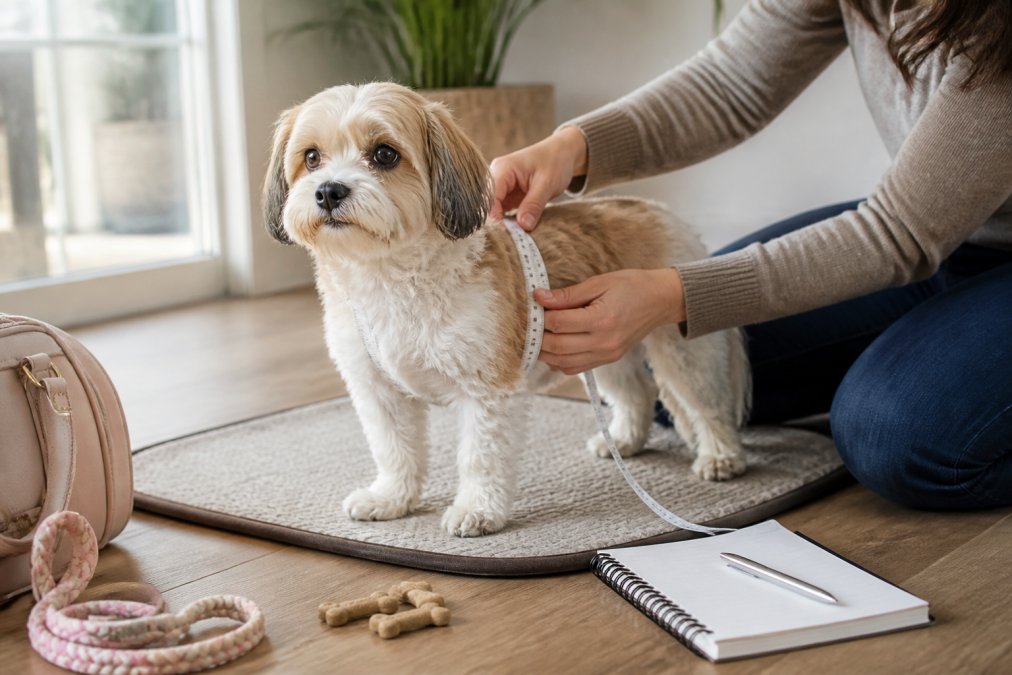
Step 1: Measure the Back Length
Back length is the distance from the base of the neck to the base of the tail, measured along the spine. This single number decides whether a sweater or hoodie covers the body without riding up.
Place the end of your tape where the neck meets the shoulders, then run it straight down the spine to the point where the tail begins. Keep the tape flat against the back and follow the natural curve of the body. Don't stretch the tape or let it sag. For a dog who arches or dips, measure along the contour rather than pulling a straight line from point to point.
Step 2: Measure the Chest Girth
Chest girth is the measurement around the widest part of the rib cage, taken just behind the front legs. It's the number that determines whether a garment or harness closes comfortably.
Wrap the soft tape around the deepest part of the chest, right behind the armpits and over the shoulder blades. The tape should sit snug against the fur but not compress it. For a dog with a thick double coat, add a small measurement buffer so the fabric doesn't pull. The chest girth is usually the largest number you'll record, and it's the one that matters most for harnesses.
Step 3: Measure the Neck Circumference
Neck circumference is the distance around the neck where a collar or garment opening naturally sits. Measure at the base of the neck, not up near the ears.
Slide two fingers under the tape before you read the number. That gap, sometimes called the two-finger rule, gives you the breathing room a collar or neckline needs. A neckline that's too tight is uncomfortable and can rub; too loose and the garment slides off during a walk.
| Measurement | Where to Measure | Why It Matters |
|---|---|---|
| Back length | Base of neck to base of tail | Garment coverage, no riding up |
| Chest girth | Widest point behind front legs | Closures, harness fit, comfort |
| Neck circumference | Base of neck, two fingers under tape | Collar and neckline comfort |
How to Measure Dog Chest for Harness: A Focused Approach
Measuring a dog's chest for a harness is slightly different from measuring for a sweater, because a harness needs to clear the shoulder joint and allow a full range of motion. The chest girth is still your anchor number, but you also want to note the distance from the base of the neck to the widest part of the chest.
A harness that fits well sits behind the shoulder blades, not on top of them. When you measure, slide your hand along the dog's side to find the point of the shoulder, then measure the girth just behind it. If the tape crosses the shoulder itself, the harness will restrict the front legs when your dog walks or runs.
Two extra checks help here:
- Measure the girth at both the deepest chest point and just behind the front legs, then use the larger number.
- Watch how your dog stands. A dog who stands narrow-chested needs a different harness shape than a broad, barrel-chested breed.
For a full breakdown of harness styles and how each one sits on the body, our dog harness sizing guide from the American Kennel Club walks through the anatomy a harness has to work around.
Your Dog Harness Sizing Guide: Getting the Fit Right
A dog harness sizing guide is only useful if it accounts for how your dog actually moves, not just how they stand. The right harness lets your dog walk, run, and sit without the straps binding, and it stays put when they pull.
Start with the chest girth you recorded, then compare it to the harness maker's size chart. Sizing varies between brands, so never assume a medium in one line matches a medium in another. Most harnesses list a girth range rather than a single number, and you want your dog's measurement to land comfortably inside that range, not at the very edge.
Then check the adjustment range. A good harness has straps you can tighten or loosen by at least a couple of inches, which gives you room to fine-tune for a snug fit without pinching. Test the fit by sliding two fingers under each strap. If you can't fit two fingers, it's too tight; if you can fit a whole hand, it's too loose.
Understanding a Dog Clothing Size Chart
A dog clothing size chart is a table that maps your dog's body measurements to a brand's numbered or lettered sizes. The chart is only as good as the measurements you feed it, which is why we take back, chest, and neck before ever opening a size chart.
Most charts list sizes by chest girth first, since that's the hardest measurement to fake. Back length comes second, and neck is often given as a range. When two of your numbers point to different sizes, size to the chest girth and check that the back length is close. Chest girth governs whether the garment closes; back length governs how it looks.
A few things to watch for:
- Some charts use weight as a shortcut. Weight vs measurement is not a reliable substitute, because two dogs of the same weight can have very different body shapes.
- Fabric stretch changes the math. A knit sweater forgives a half inch; a structured Ultrasuede® or woven jacket does not.
- Size conversion between brands is not standardized, so always re-measure rather than assuming.
Every piece is handmade in the USA with genuine upholstery-grade Ultrasuede® and finished with details like Swarovski® crystals, so the fit is precise rather than forgiving. That's exactly why we ask customers to measure twice before ordering.
Common Mistakes to Avoid When Measuring Your Dog
The most common measuring mistakes all come from the same root cause: measuring a moving target or measuring the wrong spot. Fix the setup and the numbers take care of themselves.
Here's what we see most often, and how to correct each one:
- Measuring over a thick coat without a buffer. Fur compresses under a tape, so the reading looks smaller than the dog really is. Add a small buffer for double-coated breeds.
- Letting the tape sag or twist. A tape that isn't flat against the body adds phantom length. Keep it smooth and level.
- Measuring a sitting or lying dog. Posture changes every number. Always measure standing.
- Pulling the tape tight. A tight tape gives you a garment that's too small. Snug, not tight.
- Guessing instead of re-measuring. Dogs grow, gain, and lose weight. Re-measure before every seasonal purchase.
Troubleshooting Fit Issues and Breed-Specific Tips
Fit problems usually trace back to body shape, not to the size you picked. Some breeds simply don't match a standard chart, and that's where breed-specific guidance saves you a return.
Dogs with deep chests and narrow waists, like Greyhounds and Whippets, need garments cut for a sighthound silhouette. Barrel-chested breeds like Bulldogs and Boxers need extra room through the chest and a shorter back. Long-backed breeds like Dachshunds and Corgis need a longer back length relative to their girth, or the sweater rides up over the hips. Dogs with very short legs, like Corgis and Basset Hounds, need a shorter cut so the hem doesn't drag.
For non-standard dogs, a visual aid helps more than a number. Take a photo of your dog standing next to a ruler or a yardstick, then compare that silhouette to the garment's product photos. If your dog is between sizes, size up on structured fabrics and size down on stretchy knits.
If a piece arrives and the fit isn't right, don't force it. A garment that pulls at the shoulders or gaps at the neck will only get more uncomfortable with wear. Check the maker's exchange policy before you order, and keep your measurements on file so the next order is a one-shot success. For a broader reference on canine body structure, the breed standards published by the United Kennel Club and the canine anatomy resources from the American Veterinary Medical Association are useful starting points.
Measuring your dog for clothes isn't complicated, but it is precise work, and precision is what separates a garment that looks custom-made from one that sits in the drawer. Take the three measurements, write them down, and keep them handy for every future order.
At Aventura Pups, we make that precision worth it. Our designer dog apparel is handmade in the USA from genuine upholstery-grade Ultrasuede® imported from Japan, accented with Swarovski® crystals and finished with thoughtful details like the French-style barrette mechanism on our hair bows. Every piece is built to hold its shape and its seams through real wear, so the fit you measure today still looks right next season.
Get started with Aventura Pups and give your pup a wardrobe that fits as beautifully as it's made.
Frequently Asked Questions
What are the three most important measurements for dog clothes?
The three key measurements are back length (from the base of the neck to the base of the tail), chest girth (the widest part of the rib cage, just behind the front legs), and neck circumference (the widest part of the neck where a collar sits). Taking all three ensures a snug fit without restricting movement. Always measure while your dog is standing.
Should I size up or down for dog clothes?
When your dog falls between sizes on a dog clothing size chart, size up. A measurement buffer of about two fingers under the tape ensures comfort and range of motion. Clothes that are too tight can restrict breathing and cause chafing, especially around the armpits. If the garment is too loose, it may slip off during walks or cause tripping.
How do I measure my dog's chest for a harness?
Wrap a soft measuring tape around the widest part of your dog's rib cage, just behind the front legs. Keep the tape snug but not tight, allowing room for two fingers. This chest girth measurement is the most critical number for a dog harness sizing guide. Record the number in inches and compare it to the harness manufacturer's size chart.
Does dog clothing size vary by brand?
Yes, sizing varies significantly between brands. A size medium from one maker may fit like a small from another. Always rely on your dog's actual body measurements and the specific brand's dog clothing size chart rather than assuming a universal size. Handmade and designer apparel often uses different grading, so measure fresh before each purchase.
