



Quick Summary
To keep a dog calm in a carrier, choose a well-ventilated carrier that fits, introduce it in a quiet space, and train entry with treats. Then build time inside through short, gradual sessions before any trip. A dog calm carrier should always have mesh panels so it never feels stuffy.
- Measure your dog nose to tail-base and standing height before choosing a carrier size.
- Keep the carrier open and in a familiar spot, and never force your dog inside.
- Start with the door open and add closure only once your dog eats or relaxes inside.
- Begin with 5 to 10 seconds of closed-door time, twice daily, and build up weekly.
- Never leave a dog in a parked car, since interior temperatures rise dangerously within minutes.
Table of Contents
- Why Dogs Get Anxious in Carriers and What Calm Looks Like
- Step 1: Choose a Carrier That Fits and Ventilates Well
- Step 2: Introduce the Carrier in a Quiet, Familiar Space
- Step 3: Train Your Dog to Use a Carrier With Treats and Praise
- Step 4: Build Comfort With Short, Gradual Practice Sessions
- Step 5: Calm Your Dog in a Carrier During Travel
- Troubleshooting Panic, Motion Sickness and Separation Distress
- Your Next Step: Start a Practice Routine This Week
- Frequently Asked Questions
Why Dogs Get Anxious in Carriers and What Calm Looks Like
Most dogs don't hate their carriers. They hate what the carrier has come to mean: a confined space, strange noises, and a trip they didn't choose.
A calm dog lies down, breathes slowly, and may even fall asleep. A stressed dog pants hard, paces or scrambles, whines, drools, or tries to dig its way out.
Carrier anxiety usually comes from one of three places:
- Confinement: Some dogs feel trapped when they can't see their surroundings.
- Unfamiliarity: A carrier that appears only before a trip signals that something stressful is about to happen.
- Motion and noise: Vehicles, airports, and crowds can overwhelm a dog that has no safe retreat.
The good news is that these reactions can be trained away, mostly at home, long before you leave for a trip.
Step 1: Choose a Carrier That Fits and Ventilates Well
The carrier itself matters more than most owners realize.
Measure your dog from nose to base of tail, and from the floor to the top of the head while standing. For a broader overview of the best options before you decide, see the best luxury dog carriers for small dogs.
Ventilation is just as important. Our Monaco Carrier Blush has mesh on both sides, along with YKK zippers and a front pocket for your travel essentials.

Practical check: Before buying, put a folded towel inside and have your dog lie down in it.
Our team also recommends reviewing durable luxury carrier options if you travel often and want a carrier that holds up to repeated use.
Step 2: Introduce the Carrier in a Quiet, Familiar Space
Your first goal is to make the carrier boring. Place it in a quiet room where your dog already relaxes, leave the door open, and let your dog explore at its own pace.
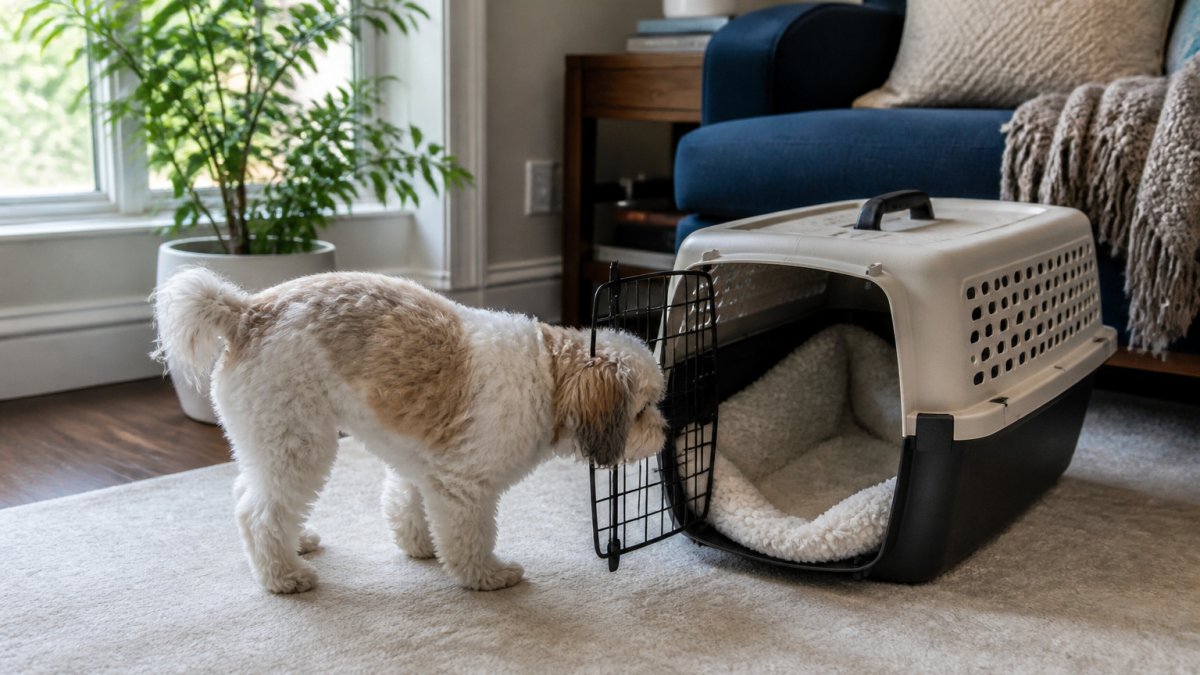
Don't force your dog inside. Pushing a nervous dog into a carrier teaches it that the carrier is something to escape. Instead:
- Keep the carrier in the same spot every day.
- Add a soft bed or familiar-smelling blanket inside.
- Let your dog sniff, step near, and walk away whenever it wants.
Progress often comes gradually when the carrier is kept open and accessible. Some dogs take longer, and that's normal. Move forward only when your dog shows relaxed body language, such as a loose tail or soft eyes.
Step 3: Train Your Dog to Use a Carrier With Treats and Praise
Once your dog is comfortable near the carrier, teach it to step inside voluntarily. This is where positive reinforcement does the heavy lifting.
Use high-value treats your dog loves. Toss a treat just inside the door, then wait.
Here's a simple progression:
- Toss a treat near the entrance.
- Toss a treat just inside.
- Toss a treat toward the back wall.
- Feed a meal inside the carrier with the door open.
- Add a treat and a gentle verbal cue, such as "in," then reward.
Keep your praise soft and steady.
Watch out: Don't close the door too early. Closing it before your dog is relaxed can trigger panic that undoes days of progress.
Step 4: Build Comfort With Short, Gradual Practice Sessions
After your dog walks in willingly, build time inside the carrier in small steps.
Try this schedule:
| Stage | Time With Door Closed | Practice Frequency |
|---|---|---|
| Week 1 | 5 to 10 seconds | 2 to 3 times daily |
| Week 2 | 30 seconds to 1 minute | 2 times daily |
| Week 3 | 3 to 5 minutes | Once daily |
| Week 4 | 10 to 15 minutes | Once daily |
Close the door, stay nearby, and reward your dog for staying calm.
Next, practice picking up and carrying your dog a short distance, such as from the living room to the kitchen.
Keep track of your progress. If your dog regresses, go back one stage and move forward more slowly.
Step 5: Calm Your Dog in a Carrier During Travel
On travel day, your preparation will show: a dog that has practiced regularly usually settles faster than one seeing its carrier for the first time. But travel day also introduces variables training can't fully control, heat, motion, noise, and long waits, so the plan below separates what to do before you leave, in transit, and if your dog's distress escalates.
Before you leave
- Exercise, but don't exhaust. A brisk walk or a game of fetch 60 to 90 minutes before departure takes the edge off without leaving your dog overheated or thirsty. Avoid intense exercise in the hour right before loading up.
- Feed light and early. Offer a small meal two to four hours before departure, following your vet's advice. A full stomach plus motion is a common recipe for vomiting.
- Set up the carrier for comfort. Place a familiar blanket or an item that smells like home inside. Add a securely fastened water bowl or a clip-on dish only if your dog won't spill it; otherwise offer water at stops.
In transit: car rides
Keep the cabin cool and the radio low. Talk softly and avoid reaching into the carrier repeatedly, which can restart a settled dog. Check on your dog at every stop, look for relaxed posture, normal breathing, and interest in water.
Plan stops every two to three hours on long drives. At each stop, offer water, a short walk on leash, and a chance to eliminate. Don't open the carrier door in a parking lot until your dog is leashed, a startled dog can bolt.
In transit: air travel and airport waits
Airline cabin rules vary, and most U.S. carriers require the pet to remain inside the carrier for the entire flight, including taxi and turbulence.
During airport waits, find a quiet corner away from gates and crowds. Cover part of the carrier with a light, breathable cloth if your dog settles better in a darker space, but never block mesh panels.
If distress escalates in transit
Know your stop conditions before you leave.
If distress is severe, includes self-injury, or recurs on every trip, stop travel and consult your veterinarian or a certified behavior professional before the next attempt.
Talk to your vet first about calming products. Ask your veterinarian about calming options that are appropriate for your dog, and only use a dose your vet has confirmed.
Troubleshooting Panic, Motion Sickness and Separation Distress
Not every struggle is the same, and the fix depends on the cause. Treating a nauseated dog with more carrier training, or a panicked dog with a bigger treat, wastes weeks and can make things worse. Use the patterns below to identify the likely cause, then match your response to it.
First, separate the three patterns
| Pattern | Typical signs | When it shows up | Likely cause |
|---|---|---|---|
| Fear or panic | Wide eyes, tucked tail, trembling, frantic scratching, nonstop barking, attempts to bolt | As soon as the carrier appears, or when the door closes | Confinement or unfamiliarity |
| Motion sickness | Drooling, lip-licking, yawning, vomiting, reluctance to get in the car | Once the vehicle starts moving, or within the first few minutes of a ride | Nausea, often worsened by a full stomach or a warm cabin |
| Separation distress | Crying, howling, chewing at the door, digging, escape attempts | When left alone in the carrier, even at home | Over-attachment or lack of practice with brief absences |
A dog can show more than one pattern. A dog that drools in the car and also cries when you leave the room needs both a motion-sickness plan and a separation plan, not one or the other.
Panic in the carrier
If your dog frantically scratches, barks nonstop, or hurls itself at the walls, stop the session and open the door. Return to an earlier training stage, and shorten your practice time. Frequent short successes can help rebuild trust. A useful rule: end every session while your dog is still calm, not after it has already panicked. If your dog panics the moment the door closes even for a few seconds, back up to rewarding voluntary entry with the door open and rebuild from there.
Motion sickness
Drooling, lip-licking, yawning, or vomiting during car rides often points to nausea rather than fear. Keep the car cool, and ask your vet about options for nausea. Position the carrier so your dog can see out a window, if possible, since a fixed view can reduce queasiness. Short, frequent rides that end before nausea starts, even five minutes around the block, build tolerance better than one long trip.
Separation distress
Some dogs cry or chew when left alone in a carrier, especially if they're strongly bonded to their owner. Practice leaving the room for a few seconds, then gradually longer, so your dog learns you always come back. Track how long your dog stays calm before it starts to fuss, and keep sessions just under that threshold, if your dog is fine for 30 seconds and then cries, practice 20-second absences, not two-minute ones.
Medication and calming products: what's safe to try
Medication decisions belong with your veterinarian, not with a training guide or an online forum. If your dog's distress is severe, ask your vet about a trial dose at home well before travel day so you can observe how your dog responds, a sedative that makes one dog sleepy can make another agitated, and dosing by weight alone misses health and age factors.
When to stop training and get help
If the behavior is severe, persistent, or includes self-injury, broken nails, chewed gums, or a dog that injures itself trying to escape, stop training and consult your veterinarian or a certified behavior professional. The same applies if your dog stops eating entirely in the carrier, shows no improvement after several weeks of consistent short sessions, or becomes aggressive when approached near the carrier.
Your Next Step: Start a Practice Routine This Week
Calm carrier travel is built on small, consistent sessions, not one big effort before a trip. Pick a carrier that fits well, set it up in a quiet room, and schedule two short practice sessions today.
If you're shopping for a new carrier, our stylish dog carriers for airplane travel guide walks through options suited to flights. You can also browse the Monaco Carrier Blush and other carriers in our collection to find one that suits your dog and your travel plans.
Frequently Asked Questions
How do I get my dog to calm down in the crate?
Start by making the crate a predictable, positive place. Put a familiar blanket or an item carrying your scent inside, and feed meals or scatter treats near and then inside the opening. Keep early sessions short, often just a few minutes with the door open, and end before your dog becomes agitated. Reward quiet, settled behavior with calm praise in a soft voice. If your dog keeps panicking despite steady, gradual practice, the problem may be fear or separation distress rather than simple unfamiliarity, and a veterinarian can help you choose a plan.
How long does it take for a dog to get used to a carrier?
There is no fixed timeline, because it depends on your dog's age, past experiences and temperament. Dogs settle at different speeds with short, positive practice sessions, with the door open at first and closed only after your dog enters voluntarily and relaxes. Puppies and rescue dogs with limited handling history may need longer. Move forward only when your dog is calm at the current step, and go back a stage if you see stress signals such as panting, whining or pacing.
Should I use treats to help my dog stay calm in a carrier?
Treats work well for building voluntary entry and a positive association with the carrier. Offer small, low-calorie rewards that your dog enjoys, and give them while your dog is inside and quiet. Avoid using food to force a dog into a carrier, which can intensify anxiety. For any calming treats, supplement or prescription medication, check with your veterinarian first, since some products interact with health conditions or other medications and dosing should be confirmed for your dog's weight and health.
What should I do if my dog panics in a carrier?
Stop the session and let your dog out calmly once they stop struggling, so the release does not reward frantic behavior. Return to an earlier, easier step, such as shorter sessions with the door open. Make sure the carrier is well ventilated and fits your dog without cramping. For travel, check that your dog is not overheated and that the carrier is secured. If panic continues, frequent, or includes self-injury or refusal to eat, consult your veterinarian about anxiety management and safe calming options.

