



Last Updated: October 25, 2026
Quick Summary
Crystal harnesses daily wear are safe when properly fitted, regularly inspected, and removed during unsupervised time at home. The key is choosing a harness designed for continuous wear with secure crystal settings and quality materials, combined with daily inspection to catch loose stones or damage before they become hazards.
- Measure your dog's chest girth and neck, then fit the harness so two fingers slide under straps without restricting leg movement.
- Inspect all crystals, backing material, and stitching after every walk to catch loose stones or damage early.
- Remove the harness during sleep, naps, and unsupervised time indoors to give your dog's skin 12-16 hours of harness-free recovery daily.
- Choose harnesses made with quality materials like Ultrasuede fabric and Swarovski crystals set with lead-free formula for durability.
- Watch for red marks lasting longer than an hour, hair loss, or raw patches on skin, which signal the harness needs adjustment or removal.
Table of Contents
- Are Crystal Embellished Dog Harnesses Safe for Daily Use?
- How to Measure a Dog for a Harness That Fits Properly
- How Should a Dog Harness Fit for Comfort and Safety
- Crystal Detachment and Choking Hazards: What You Need to Know
- Dog Harness Chafing: Prevention and Daily Inspection
- Should a Dog Wear a Harness All the Time? Daily Use Guidelines
- Your Daily Crystal Harness Inspection and Care Routine
- Choosing a Crystal Harness Built for Daily Wear
- Frequently Asked Questions
Are Crystal Embellished Dog Harnesses Safe for Daily Use?
Crystal harnesses daily wear are safe when they're properly fitted, regularly inspected, and removed during unsupervised time at home.
Here's what matters: a harness that fits correctly won't chafe your dog's skin. Crystals won't detach if they're securely set and the harness is made from quality materials.
We've analyzed the research on dog-worn equipment, and the consensus is clear. According to a review of dog-worn equipment published in Frontiers in Veterinary Science, studies generally focus on pressure points and comfort, and harnesses that fit properly distribute weight evenly across the shoulders and chest rather than concentrating force on the neck.
At Aventura Pups, we create crystal harnesses daily wear using premium materials like Swarovski crystals and plant-based Ultrasuede fabric.
But daily wear comes with responsibility.
How to Measure a Dog for a Harness That Fits Properly
A harness that doesn't fit is the root cause of most comfort problems. Too tight and it restricts breathing and movement. Too loose and your dog can slip out or the straps dig into skin unevenly. Measuring takes five minutes and prevents weeks of irritation.
Measuring Your Dog at Home
Start with soft measuring tape, the kind tailors use, not a rigid ruler. You'll need two measurements: girth (the circumference around your dog's chest) and neck.
For chest girth:
- Wrap the tape around the widest part of your dog's ribcage, just behind the front legs
- Keep the tape snug but not tight, you should fit one finger between the tape and your dog's body
- Write down the number in inches
For neck:
- Measure around the base of your dog's neck where a collar would sit
- Use the same one-finger rule for comfort
- Record this measurement
Most crystal harnesses are sized by chest girth, so that's your primary number. Detailed sizing guidance is available in our fitting guide, which walks you through size selection step-by-step. If your dog falls between sizes, measure twice and compare to the sizing chart. detailed sizing guidance is available in our fitting guide, which walks you through size selection step-by-step.
Checking the Fit After Purchase
When your crystal harness arrives, put it on your dog and run the fit test.
The harness should:
- Allow two fingers to slide under the straps at the chest and shoulders
- Not restrict your dog's front leg movement, your dog should be able to lift legs naturally
- Sit flat against the body without twisting or bunching
Walk your dog for 10 minutes. Watch for any signs of rubbing or pressure marks where the straps contact skin. If you see red marks that don't fade within 30 minutes after removing the harness, the fit needs adjustment.
How Should a Dog Harness Fit for Comfort and Safety
The right fit means your dog's weight is distributed across the strongest parts of the body: the shoulders, ribs, and back. A poorly fitting harness concentrates pressure on soft areas like the armpits and throat, which causes irritation and discomfort.
Comfort and safety are inseparable. A comfortable harness keeps your dog calm during walks, which means fewer sudden pulls and less strain on the attachment points.
Research on dog equipment shows that harnesses designed to avoid the neck are significantly safer than collars. According to a comprehensive review in PubMed Central, tightening harnesses and certain collar types may be less comfortable and should be used with caution.
Look for these features in a quality crystal harness:
- Adjustable straps at multiple points (chest, girth, neck) so you can fine-tune fit as your dog grows or changes weight
- Reinforced stitching at stress points where the D-ring attaches and where straps join the body
- Soft interior padding to prevent chafing even during extended wear
The Swarovski Flowers harness from Aventura Pups includes all of these.
Crystal Detachment and Choking Hazards: What You Need to Know
This is the question every responsible dog owner asks: can crystals come loose and become a choking hazard?
The short answer is yes, crystals can detach if they're not set properly or if the harness is subjected to extreme stress.
Crystals are most likely to come loose when:
- The backing or setting is damaged by sharp impacts or being caught on rough surfaces
- The harness is pulled hard during a sudden lunge or escape attempt
- The crystal was never fully secured during manufacturing
Here's what to watch for:
- Loose crystals or gaps where a crystal used to sit, this is your signal to stop daily wear and inspect the harness
- Cracks or discoloration in the backing material around crystals
- Visible glue or adhesive that looks dried out or separated
If you find any of these issues, remove the harness and set it aside for repair or replacement.
Prevention is simpler than repair. Daily inspection, which we'll cover in the next section, catches problems before they become dangerous.
Dog Harness Chafing: Prevention and Daily Inspection
Chafing happens when fabric rubs repeatedly against skin, usually at pressure points like the armpits, shoulders, or where straps cross the chest.
Common chafing locations:
- Inside the front legs where the chest strap sits
- Along the sides where the girth strap wraps around the ribs
- Behind the shoulders where the back strap attaches
- Anywhere the crystal backing material directly contacts skin
Prevention starts with fit. A harness that's too tight or positioned incorrectly will chafe within hours.
Daily inspection prevents problems. After each walk, remove the harness and check your dog's skin for:
- Red marks or pressure lines that fade within 30 minutes (normal)
- Red marks that persist longer than an hour (sign of pressure)
- Any hair loss, raw patches, or skin breakdown (immediate action needed)
- Wet or matted fur that suggests the harness trapped moisture
If you see persistent redness or any skin damage, give your dog a break from the harness for 24-48 hours and apply a soothing balm to the affected area.
Should a Dog Wear a Harness All the Time? Daily Use Guidelines
Dogs should not wear a harness continuously, 24 hours a day.
Here's a practical daily schedule:
- Walks and outings: Wear the harness during walks, training sessions, and any time your dog is on leash outside
- Home and supervised time: Remove the harness indoors when you're actively watching your dog
- Sleep and rest: Remove the harness at night and during nap times
- Alone time: Never leave a harness on an unsupervised dog, especially if they're crate-trained or in a confined space
This rhythm gives your dog's skin 12-16 hours of harness-free time each day, which is plenty for full recovery from any minor pressure or moisture.
Some dog owners worry that removing a harness will confuse their dog or undo training. It won't.
Watch out: leaving a harness on an unsupervised dog creates real risks.
Your Daily Crystal Harness Inspection and Care Routine
Five minutes of daily inspection and care will keep your crystal harness looking beautiful and functioning safely for years.
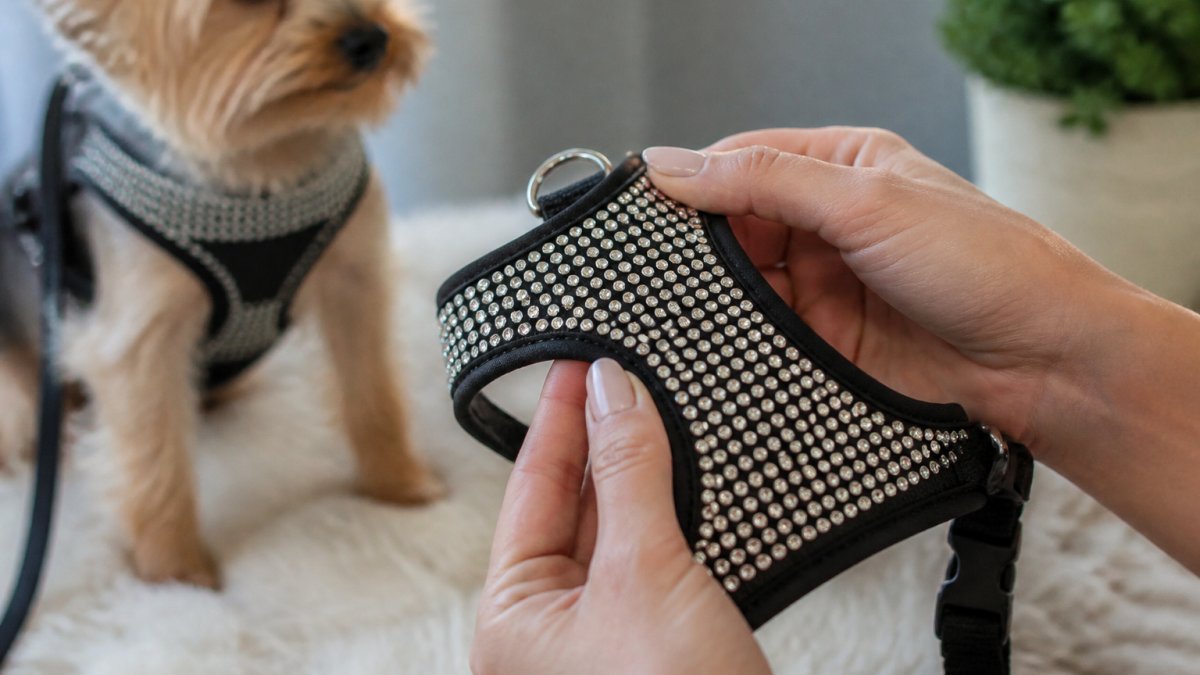
After every walk, follow this routine:
- Remove the harness and lay it on a clean surface
- Run your fingers over all crystals to check they're secure and not loose
- Inspect the backing material around each crystal for cracks or separation
- Check the stitching at stress points (D-ring attachment, strap joints) for fraying or damage
- Look for dirt, debris, or moisture trapped under straps or around crystals
- Examine your dog's skin for red marks, hair loss, or irritation
- Store the harness in a cool, dry place away from direct sunlight
Weekly deep clean:
Remove any dirt or debris with a soft brush.
If you notice any damage during inspection, address it immediately. A loose crystal is an easy fix if caught early.
Check your crystal harness after every walk using this simple seven-step routine.
| Step | Action | Purpose |
|---|---|---|
| 1 | Remove harness and lay on clean surface | Prepare for inspection |
| 2 | Run fingers over all crystals | Check they are secure |
| 3 | Inspect backing material around crystals | Look for cracks or separation |
| 4 | Check stitching at stress points | Detect fraying or damage |
| 5 | Look for dirt, debris, or moisture | Prevent skin irritation |
| 6 | Examine dog's skin | Identify red marks or hair loss |
| 7 | Store in cool, dry place | Preserve harness condition |
Choosing a Crystal Harness Built for Daily Wear
Not all crystal harnesses are created equal. Some are designed for photo shoots and special occasions, beautiful but fragile.
Here's what separates a daily-wear crystal harness from a decorative one:
Material quality: The fabric should be durable, breathable, and washable. Ultrasuede is an excellent choice because it's engineered from plant-based materials, maintains its shape after washing, and doesn't trap moisture. Nylon or polyester without padding will chafe during extended wear.
Crystal security: Crystals should be set with a backing material that won't separate or degrade.
Stitching and hardware: Stress points need reinforced stitching.
Design for movement: The harness should allow full front-leg movement without restricting the shoulder joint.
The Swarovski Flowers harness meets all these criteria. At $140, it's an investment. Learn whether premium crystal harnesses justify their cost for daily wear.

For dogs with more active lifestyles or larger sizes, the Swarovski Shimmer Black harness at $185 offers a four-row crystal design.
Frequently Asked Questions
Are rhinestones or crystals on a dog harness safe?
Swarovski crystals used in quality harnesses are safe when properly secured. Lead-free crystals with proprietary coatings maintain durability through years of wear. The risk comes from loose or poorly attached stones that can detach and become choking hazards. Check your harness weekly for any loose crystals, especially after walks or water exposure. Quality brands like Aventura Pups use innovative crystal attachment methods to prevent detachment during daily use.
How tight should a dog harness be?
A properly fitted harness should allow one finger to slip comfortably between the harness and your dog's body. If you can fit more than one finger, it's too loose and your dog could slip out. If you cannot fit a finger at all, it's too tight and will cause chafing and restrict movement. Check the fit regularly as your dog grows or changes weight. Adjustable straps on quality harnesses like the Swarovski Flowers collection let you fine-tune the fit for all-day comfort.
Can a dog harness cause chafing or hair loss?
Yes, harnesses that are too tight, poorly fitted, or worn continuously without breaks can cause chafing, skin irritation, and hair loss, especially in areas with pressure points. Soft, high-quality materials like Ultrasuede reduce this risk compared to rough nylon. Remove the harness for several hours daily to allow your dog's skin to breathe. Inspect the underarm and chest areas weekly for redness or irritation. Ensure adjustable straps fit snugly but not restrictively to prevent movement-related friction.
Should a dog wear a harness all the time?
No, even the most comfortable harness should not be worn continuously. Remove the harness for at least 4-8 hours daily, especially during sleep and rest periods at home. Prolonged, uninterrupted wear can restrict natural movement, create pressure points, and cause skin irritation. Supervise your dog during the first few hours of wearing a new harness to ensure comfort. For daily outdoor activities like walks, a properly fitted harness is safe; indoors and at night, let your dog go harness-free to move freely and allow skin recovery.
Crystal harnesses are safe for daily wear when you choose quality materials, measure your dog correctly, and commit to a simple daily inspection routine. The crystals aren't the risk, poor fit, inadequate stitching, and neglected maintenance are. Start with a harness built for daily use, remove it during rest and sleep, and check for loose stones and chafing every single day. Your dog gets the beauty of luxury accessories with the comfort and safety they deserve.

